
होमKabaddiCommonwealth Kabaddi Championship 2026: India vs Nigeria — Three Wins, but Iran's Absence Clouds the Dominance Narrative
Kabaddi
Commonwealth Kabaddi Championship 2026: India vs Nigeria — Three Wins, but Iran's Absence Clouds the Dominance Narrative
संक्षिप्त उत्तर: राष्ट्रमंडल कबड्डी चैंपियनशिप 2026 के चौथे दिन भारत का सामना नाइजीरिया से है। भारत ने तीनों मैच जीते हैं — इंग्लैंड को 46-26, युगांडा को 44-30 और मलेशिया को 37-23 से (कुल 127 अंक बनाए, 79 लुटाए)। नाइजीरिया तंजानिया से 17-66 और इंग्लैंड से 18-68 हारा है, यानी 49-50 अंकों के अंतर से। भारत भारी पसंदीदा है, लेकिन उसकी जीत का असली पैमाना अंतराल है, नतीजा नहीं। महत्वपूर्ण संदर्भ: ईरान इस टूर्नामेंट में नहीं है (राष्ट्रमंडल सदस्य नहीं), जबकि ईरान 2018 एशियाई खेलों का पुरुष कबड्डी स्वर्ण विजेता है और भारत का सबसे बड़ा प्रतिद्वंद्वी माना जाता है — इसलिए भारत का दबदबा वास्तविकता से बड़ा दिखता है। स्रोत में खिलाड़ीवार आंकड़े नहीं हैं, इसलिए एक स्टार रेडर पर निर्भरता या रक्षा की असली मजबूती साबित नहीं की जा सकती; केवल इंग्लैंड के नाइजीरिया के खिलाफ 68 और भारत के खिलाफ 26 अंक (42 अंकों का दमन) भारतीय रक्षा के पक्ष में सबसे मजबूत संकेत है। यह 'राष्ट्रमंडल' ब्रांडिंग वाला स्वतंत्र इवेंट है, राष्ट्रमंडल खेलों का हिस्सा नहीं; इसकी प्रतिष्ठा एशियाई खेलों और कबड्डी विश्व कप से नीचे है।
On Day 4 of the Commonwealth Kabaddi Championship 2026, the Indian men's team faces Nigeria. On paper it is a one-sided contest, but its analytical significance goes well beyond the scoreboard. India have won all three of their matches — 46-26 against England, 44-30 against Uganda and 37-23 against Malaysia. Across those three games they scored 127 points and conceded 79. Nigeria's record is the mirror image: a 17-66 loss to Tanzania and an 18-68 loss to England, margins of 49 and 50 points respectively. The question, therefore, is not whether India will win. The question is what that win actually proves, and what this tournament says about the real strength of Indian kabaddi.
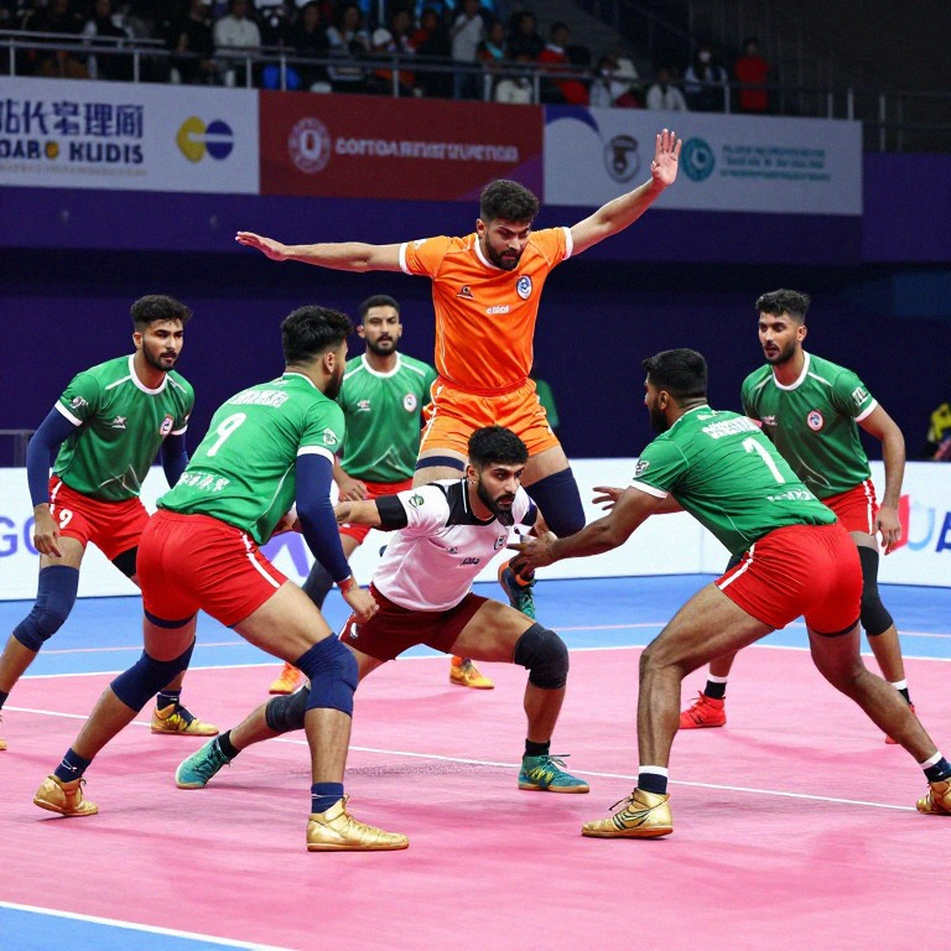
Some context is necessary for readers unfamiliar with the sport. Kabaddi is a seven-a-side contact team sport. A raider crosses into the opponent's half, touches a defender and must return safely to his own half within 30 seconds — the raid, kabaddi's equivalent of a one-man breakaway. Throughout the raid he must continuously chant 'kabaddi, kabaddi' to prove he is not inhaling; if the chant breaks, the raid is void — this cant rule is where the sport gets its name. The defending side collectively stops the raider in their own half; that is a tackle. When an entire side is ruled out, the opponent earns two bonus points and the whole team revives — the All Out, which is the engine behind kabaddi's fast scoring and frequent comebacks. After two consecutive empty raids, the third becomes a mandatory attack, the Do-or-Die raid; if that also yields nothing, the raider himself is out. And when the defending side has three or fewer players on court, a completed tackle is worth two points — the Super Tackle.
With these rules in mind, the scorelines themselves indicate that the tournament is being played under standard professional rules. Scores of 46, 44 and 37, and on the other side 68 and 66, point to repeated All Outs — a fast-tempo, aggressively raiding game. The source does not explicitly state whether the court is rectangular or circular, but a multi-nation federation event would almost certainly use the rectangular Standard Style; Circle Style cannot be fully excluded, though it is unlikely.
India's campaign is flawless in terms of wins, not in terms of margins. Their three victory margins were 20, 14 and 14 points. The report describes India's start as 'with a bang' and calls them 'clear favourites', yet the same report concedes that India have 'not won by a big margin' and that fans are 'disappointed'. The data supports the skeptical reading: margins of 20, 14 and 14 are comfortable but not dominant. Conceding 79 points while scoring 127 is not normal for a side regarded as the strongest in the field.
There is, however, an important cross-reference that works in favour of India's defence. England scored 68 against Nigeria, but the same England were restricted to 26 against India — a 42-point suppression. This is the sharpest tactical signal available in this report: India's defence is functioning against a side that is itself capable of posting a big score. India's apparently 'modest' margins become somewhat more solid in that light.
Even so, conceding 23 to 30 points every match is a yellow flag. A genuinely dominant defensive side in a field this weak would typically concede less. India's defence may be good enough to win comfortably, but it is not airtight. That gap will matter against stronger opposition.
India are captained by Surjeet Singh, the only player named in this report. It is clear that he is the captain, but it is not clear whether his on-court role is raider, defender or all-rounder. In kabaddi, captaincy often goes to a senior defensive anchor or a tactically astute leader, but that is speculation, not verified fact.
This is where the report's biggest limitation becomes visible: the source provides only team totals, not player-level statistics. No successful raid percentage, no tackle counts, no individual point tallies. It is therefore impossible to test whether India's attack depends on a single raider. That is a data gap, not an all-clear. There is no information on bench depth or rotation either.
The Nigeria fixture should be read through the same lens. Treating the 49- and 50-point margins as purely a talent gap is only half the truth. In kabaddi, an All Out revives the entire team and gives the opponent two bonus points; once dominance is established, the opposition is repeatedly wiped out and the gap compounds rapidly. Kabaddi blowouts are rule-amplified, not merely talent-driven. The size of Nigeria's defeats reflects that mechanism.
The tournament shows a clear three-tier structure. Tier one: India. Tier two: England, Tanzania, Malaysia, Uganda. Tier three: Nigeria, whose 49-50 point margins define the floor of that tier. This classification comes from scorelines, not from any ranking.
The single most important fact in this whole picture, however, is the one that is not on the court: Iran's absence. Iran is the nation that has genuinely beaten India at the top level — Iran won the men's kabaddi gold at the 2026 Asian Games. Iran is not a Commonwealth member, so it cannot play in this tournament. The consequence is that India's three straight wins come against tier-two and tier-three opposition, and India's dominance appears larger than it is. Globally, kabaddi's real picture is bipolar — India and Iran — and this tournament masks that.
The event's prestige also needs to be stated plainly. This is a standalone championship under 'Commonwealth' branding, not part of the Commonwealth Games — kabaddi is not on the Commonwealth Games programme at all. Its prestige sits below the Asian Games, the Kabaddi World Cup and the Asian Kabaddi Championship. It is not a step on any international prestige ladder; it is a separate event.
The word 'Commonwealth' here is a soft-power move. The aim is to present kabaddi as a shared sport of the Anglophone world and extend its reach into Africa and Southeast Asia. That internationalisation is broad but shallow: many flags, few competitive nations. Nigeria's heavy defeats are a symptom, not an exception. Only six teams appear in the source — India, England, Malaysia, Uganda, Tanzania and Nigeria. Deep-kabaddi nations such as Pakistan and Bangladesh, both Commonwealth members, are absent from that list, but the source does not confirm their absence, so it should be treated only as a possibility.
To understand kabaddi's place in India, one comparison helps. It is India's most-watched non-cricket sports property, rooted in village akhadas and in the recruitment traditions of government jobs — railways, police, army. The Pro Kabaddi League turned that folk tradition into a televised professional league. For India, kabaddi is roughly what a nationally beloved folk sport becomes when it turns professional. And because of that strength, India's talent-pipeline advantage remains out of reach for tier-three nations for now.
African participation — Nigeria, Tanzania, Uganda — is at the development stage, not the competitive stage. Their presence signals outreach, not depth. Part of this championship's purpose is to accelerate kabaddi's growth in Africa and Southeast Asia, an objective distinct from competitive balance.
On the commercial side, the source itself offers a signal: the report is fundamentally a 'LIVE streaming and telecast' guide. Distribution is therefore primarily online, not premium broadcast. That is a commercial signal that the event's broadcast-rights tier sits below the Pro Kabaddi League or the Asian Games. No sponsorship value, rights fee or player salary data is available, so no commercial risk judgment is possible. It should also be made clear that this is not a franchise event like the PKL, so auction or 'auction premium' analysis does not apply here at all.
At the governance level, the main risk is opacity, not scandal. The source does not say who the organiser is, whether there is International Kabaddi Federation recognition, or what the referee and video-review arrangements are. Kabaddi has a history of parallel and disputed federations, so these questions are not trivial. 'Commonwealth' branding without Commonwealth Games status creates a prestige-inflation risk for readers.
Nor is this event a major step on the Olympic path. Kabaddi's route to the Olympics is blocked by structural criteria — the number of participating countries, continental coverage and the depth of the women's game. This tournament's field is thin and lacks strong teams such as Iran and Korea, so it does nothing to close those gaps.
The risk list is clear. First, reading 'three out of three' as global dominance while Iran is absent — the biggest analytical risk. Second, conceding 23 to 30 points a game, exposing defensive softness against elite raiders. Third, dependence on a single star raider — which can neither be confirmed nor ruled out because player-level data does not exist. Fourth, tier-three nations remaining structurally uncompetitive, which will cap the tournament's competitive value for the foreseeable future.
In the Nigeria match, the thing to watch is not the result but the margin. India are overwhelming favourites, but the analytical value lies in how big they win — a direct proxy for the team's attacking sharpness. If the margin goes beyond 40, the earlier 'modest' margins can be partly discounted. If it stays around 20, questions over both attack and defence will persist. India's real test in this tournament, if a knockout stage exists, would come against a side like England, the one team here capable of posting a big score. The source does not state whether there is a knockout stage, so that too remains an open question.
The essence of this analysis is that India are winning this tournament, but those wins are not proof of their global level. Iran's absence, the lack of player-level data and the scores built against tier-three teams together show that the picture is not as clean as it looks. The Day 4 result will probably go as predicted. The real answer will come in later matches, and against a rival like Iran — one that is not on the court here.

संबंधित खिलाड़ी
अनुशंसित
Report Cannot Be Published: Insufficient Input Data2026-10-31
Commonwealth Kabaddi Championship 2026: Surjeet Singh Named Captain, Naveen Kumar Vice-Captain — Why This Leadership Choice Is About Rulebook Leverage, Not Reputation2026-10-22
Commonwealth Kabaddi Championship 2026: Surjeet Singh Named Captain, Naveen Kumar Vice-Captain — What the Announcement Left Out2026-10-22
A Rs 5 Crore Purse, a Rs 17.4 Lakh Top Bid: the Real Story in the Kabaddi Champions League's Expansion Is Buried in the PKL's Broadcast Crisis2026-11-09
Commonwealth Kabaddi Championship 2026: Surjeet Singh Captain, Naveen Kumar Vice-Captain — What the Press Release Doesn't Say2026-10-22
Commonwealth Kabaddi Championship 2026, Day 1: The Table Is Arithmetically Right, the Picture Is Not2026-11-03
Source Material Missing: What Is Needed Before Producing a 4,279-Word Kabaddi Analysis2026-11-08
Commonwealth Kabaddi Championship 2026: Surjeet Captain, Naveen Vice-Captain — A Process Audit of an Appointment2026-10-22
अनुशंसित
The Missing Match in Kabaddi Analysis: Empty Input Exposes a Weak Link in Sports Reporting2026-11-07
Report Cannot Be Published: Insufficient Input Data2026-10-31
The Silence After the Bid: An Autopsy of Kabaddi's Money Architecture2026-11-01
Kabaddi Champions League: A Rs 5 Crore Purse and 10 Franchises — While the Real Question Is PKL's Missing Broadcaster2026-11-04
Kabaddi Sports Report Requires Verified Source Material Before Original Analysis2026-11-09
Valid but Empty: Kabaddi's Three Ledgers and One Missing File2026-10-31
India’s 3-0 Start Hides the Real Story Before Nigeria Test at the Commonwealth Kabaddi Championship2026-11-11
Empty Sheet, Missing Article: The Kabaddi Data-Pipeline Failure Nobody Audits2026-11-03